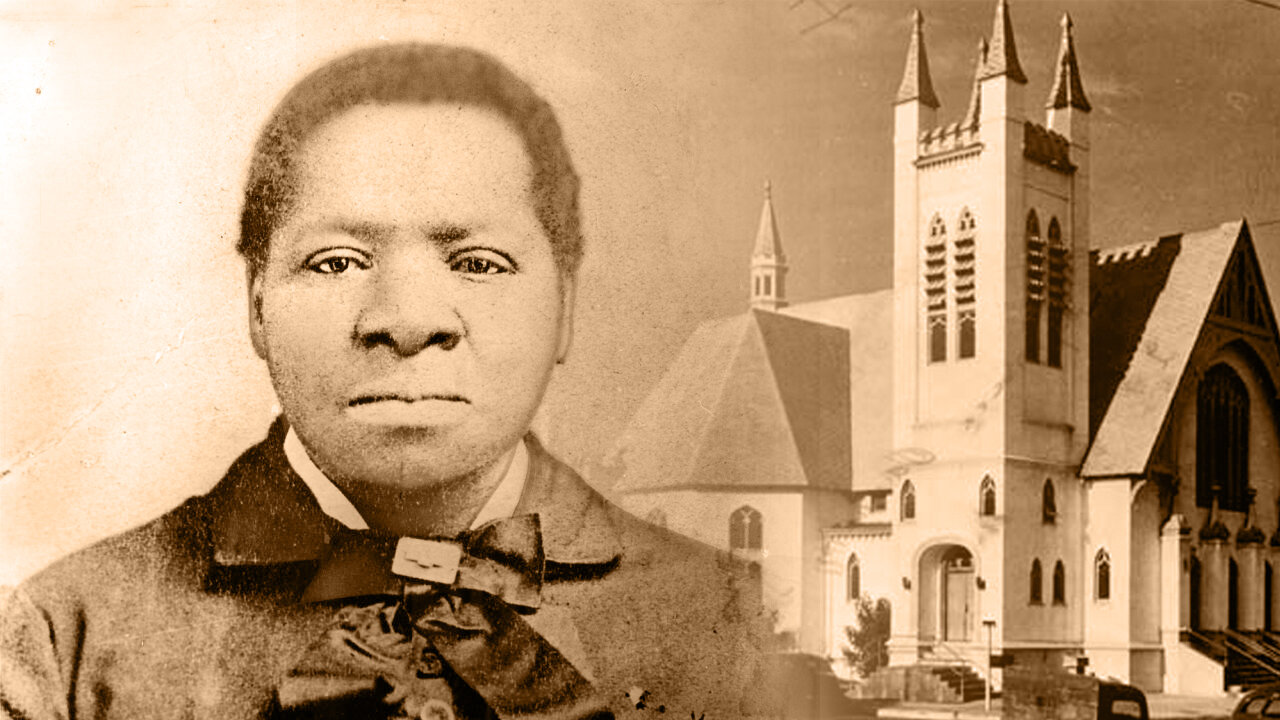
Biddy Mason was one of the first Black landowners in Los Angeles. Bridget “Biddy” Mason, born a slave in Hancock County, Mississippi, on August 15th in 1818. Although born in Mississippi, Mason was owned by slaveholders in Georgia and South Carolina before she was returned to Mississippi. Robert Marion Smith and his wife Rebecca, her last owner, were Mississippi Mormon converts. She was presented as a wedding gift when Robert and Rebecca were married. This was the life of an enslaved Black woman in the Deep South. She was property to be bought, sold, punished and even violated if the master so pleased.
Beginning in 1847, Smith decided to follow the call of the church and moved his family and enslaved persons to the West. There he would help establish a Mormon community in what would become Salt Lake City, Utah. At this time Utah was still a part of Mexico. By this time, Biddy had three daughters of her own. In 1847, she traveled, mostly on foot, from Mississippi to Utah with the Smith household. While the Smith family traveled in wagons and on horseback, Biddy walked behind. Mason’s journey West was arduous and cruel.
Along the 1,700 mile, 300-wagon caravan trek, Mason set up and broke down the camp, cooked the meals, herded cattle and served as a midwife. For seven months, she trekked 1,700 miles from Mississippi to Utah with her 10-year-old daughter, 4-year-old daughter and an infant on her breast. Their caravan eventually arrived in the Holladay-Cottonwood area of the Salt Lake Valley. The Smiths stayed only a few short years in Salt Lake City. In 1851, Smith moved his family once again. This time a 150-wagon caravan headed for San Bernardino, California.
Ignoring Brigham Young’s warning that slavery was illegal in California, Smith brought Biddy and other enslaved people to the new Mormon community. Along the way, Mason met Charles H. and Elizabeth Flake Rowan, a free Black couple. The Rowan’s, and others, urged her to legally contest her slave status once she reached California. California was admitted to the Union in 1850 as a free, non-slave state, which meant Smith was holding Mason illegally. The California Constitution was rare in its powerful denunciation of slavery, promising, "Neither slavery nor involuntary servitude unless for the punishment of crimes shall ever be tolerated in this state."
During her time there, Biddy befriended other free Blacks who told her about this law, although she seems to have been unsure as to whether it applied to her as she continued to serve the Smith family. Nervous that the authorities would try to take away his property, Smith moved his family and enslaved people to an encampment in the Santa Monica Mountains and planned an escape to slavery-friendly Texas. Robert Owens, a Black cowboy who owned several stables in Los Angeles, headed a posse of vaqueros (cowboys), who together insisted that Mason and her people had a right to remain free and in California. They headed to California to tracked Smith down and to prevent Smith from leaving the state.
The local sheriff presented a writ of habeas corpus demanding that Biddy and her fellow enslaved people be released. Robert and Rebecca Smith fought the decree and the case ended up in front of Judge Benjamin Hayes of the First District Court in Los Angeles. Because she spent five years enslaved in a “free” state Bridget Mason was able to challenged Robert Smith for her freedom. Mason knew the stakes. She’d been born into Mississippi’s plantation system and feared the tortures of slavery and reprisals her children would face if they were taken to Texas. On January 19, 1856 she petitioned the court for freedom for herself and her extended family of 13 women and children.
Biddy sued her master for her and her family’s freedom, a full year before the infamous Dred Scott v. Sandford decision. Even with California's strong anti-slavery stance, the law was very much in favor of Whites over Blacks and other people of color. In fact, it was illegal for a person of color to testify against a White person in court. Robert Smith had bribed Biddy's lawyer not to appear in court. Despite these unfavorable conditions, Judge Hayes took a particular interest in Biddy's case. He met in private with Biddy and the other people Smith owned, to hear their side of the story. Los Angeles District Judge Benjamin Hayes took three days before handing down his ruling in favor of Biddy and her extended family.
He cited California’s 1850 constitution which prohibited slavery. In a landmark decision heralded in California newspapers, Judge Hayes wrote that "all of the said persons of color are entitled to their freedom and are free forever". One of the first things Biddy did as a free woman was to choose a last name for herself. For the rest of her life, she was known as Biddy Mason. She and her daughters lived alongside the Owens family, who continued to be terrific supports and close friends. In 1860, she received a certified copy of the document that guaranteed her freedom.
With the press coverage from the court case, Mason caught the attention of Dr. John Strother Griffin, a prominent White physician who offered her work as a midwife. Mason also acted as a nurse to inmates in the county jail. She continued working as a nurse midwife, saved her money. Mason was a shrewd businesswoman too. By 1866 she was able to purchased land in what is now the heart of downtown Los Angeles. Her homestead on Spring Street would become a refuge, not only for her growing family, but for all Los Angelenos in need of a helping hand.
Philanthropically, she found many ways to aid others. She started a church, the first African Methodist Episcopal Church (A.M.E), the oldest African American Church in the city, in 1872. She hosted the Black congregation in her home, which was foundational in the establishment of Black religious life and culture in the city. She also helped start an orphanage, and always made time for patients who needed help. Mason continued to buy property and her wise investments led to an accumulated fortune of about $300,000, much of which she gave toward numerous charitable projects.
Because of her kind and giving spirit, many called her "Auntie Mason" or "Grandma Mason". She started an elementary school for Black children and a traveler's aid center. Despite all of her wealth, she continued to serve the community treating anyone in need, Black or White, as well as those no one else wanted to help, such as prisoners. Bridget Biddy Mason is still regarded as one of the most influential Black women whose contributions and faith shaped African American religion, culture, and community in the western United States. Bridget Biddy Mason life was a true ‘rags to riches’ story, she started out as a slave and ended as one of the wealthiest women in California.