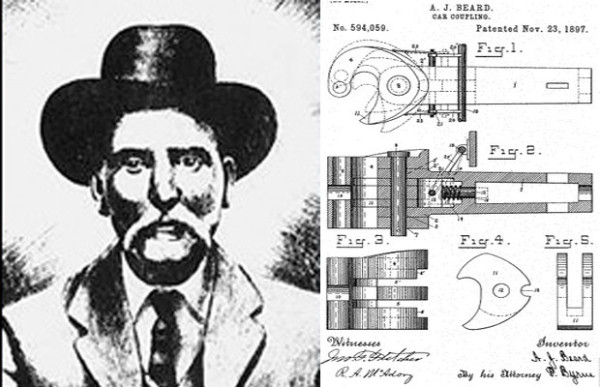
Largely self educated, Andrew Jackson Beard invented, among other things, a specially designed double plow, a type of rotary steam engine, and a device for the automated coupling of railroad cars that has been credited with saving many lives. Born a slave in Jefferson County, Alabama in 1849 (like most slaves, exact record of his birth wasn’t kept), Andrew Beard spent the first fifteen years of his life as a slave on a small farm in Alabama. Prior to the end of the Civil War, Beard was formally emancipated and released from bondage.
A year after he was emancipated, he married and became a farmer in a small city outside of Birmingham. Andrew Beard was not just a farmer, he was carpenter, blacksmith, railroad worker, businessman and finally an inventor. Recalling visiting Montgomery in 1872, a 90 mile trip, with 50 bushels of apples drawn by oxen, he said, “It took me three weeks to make the trip. I quit farming after that.” Instead, he built and operated a flour mill in Hardwicks, Alabama. He began pondering the mechanics of his subsequent plow invention. In 1881, he patented the plow, and sold the patent rights for $4,000 in 1884.
In 1887, Andrew Beard patented a second plow and sold it for $5,200. This patent was for a design that allowed the pitch of the blades of plows or cultivators to be adjusted. Beard invested the money he made from his plow inventions into a profitable real-estate business. These two inventions earned him almost $10,000, with which he began to invest in real estate. Following his stint in real estate, Andrew Beard began to work with and study engines. In 1889, Beard invented a rotary steam engine, patented on July 5, 1892. This came at a time when the United States was seeking out new power sources to help drive industrialization as well as cheaper alternatives to electricity.
Beard claimed that his new rotary steam engine was both safer and more affordable than other versions of the rotary steam engine available on the market, but it only saw limited use and never gained popularity. Beard was not discouraged by this setback and continued inventing. While Beard worked on his rotary steam engine, he experimented with the automatic car coupler idea. In the early days of American railroading, coupling was done manulaly. It did the dangerous job of hooking railroad cars together. Beard, himself had lost a leg in a car coupling accident. His experience of working on the railroad had taught him that coupling two railroad cars together was extremely dangerous.
A worker would have to brace himself between the two cars and then drop a pin at exactly the right moment. If the worker was off by one second he might severe damage his arm or leg. As an ex-railroad worker, Andrew Beard had the right idea that probably saved countless lives and limbs. The result of his efforts was a device known as the “Jenny coupler.” The device consisted of two interlocking pieces that were each attached to the coupling parts of opposing ends of railroad cars and automatically locked together when the cars bumped together. Beard was awarded a patent for the “Jenny coupler” in September of 1897. Thanks to his new invention, Beard helped save countless lives and limbs.
Beard sold the rights to his revolutionary invention back to the railroad industry for $50,000, a substantial amount at the time, and the railroad industry was revolutionized. The same year that Beard patented his coupler, Congress enacted the Federal Safety Appliance Act. The Act made it unlawful to operate railroad cars that were not equipped with automatic couplers. He obtained other patents for the coupler and by one account may have made more than $1 million, with which he purchased real estate and started a taxi line in Jefferson County.
On November 23, 1899 Andrew Beard was granted a patent for an improvement to the railway car coupler. In all, Beard received three patents for automatic car couplers. The railroad industry had transformed not only travel but also communication, distribution, and the transport of goods around the country. Historians are unsure why it was named the “coupling Jenny” or “Jenny coupler”. But Beard’s “Jenny coupler” should not be confused with Eli Janney’s “Janney coupler” which was patented in 1873. Beard’s coupler was performed automatically, which was an improvement to the Janney coupler.