In 1914, a political assassination ignited decades of rising tensions among European powers, triggering the start of World War I. Most Americans were very reluctant to get involved and remained neutral for the better part of the war. The United States only declared war when Germany renewed its oceanic attacks that affected international shipping, on April 6, 1917. President Woodrow Wilson asked a joint session of Congress for a declaration of war on April 2, 1917. It passed the the Senate on the same day and the House of Representatives four days later on April 6th. Blacks have participated in every military conflict since the inception of the United States, prepared for involvement. A new chapter in Black military history would be written: African Americans in World War I.
Almost immediately the African American press used Wilson’s words to frame the war as a struggle for African American civil rights. “Let, us have a real democracy for the United States and then we can advise a house cleaning over on the other side of the water” the Baltimore Afro-American newspaper asserted. “Colored folks should be patriotic,” the Richmond Planet newspaper insisted, “Do not let us be chargeable with being disloyal to the flag.” Thus for African Americans, the war became an important test of America’s commitment to the ideal of democracy and the rights of citizenship for all people, regardless of race. The American government mobilized the entire nation for war and African Americans were expected to do their part. Large segments of the Black population, however, remained hesitant to support a cause they deemed hypocritical.
After the declaration of war, more than 20,000 Blacks enlisted in the military, and the numbers increased when the Selective Service Act was enacted in May 1917. However, many of these World War I African Americans who enlisted or were drafted found themselves in noncombative support roles. The Marine Corps excluded Blacks entirely, the Navy restricted their service to menial roles as cooks and stewards, and the Army’s four segregated units were assigned guard duty on the Mexican border and never went abroad. Despite this, patriotic spirit of the era encouraged Black men and women to enlist in the military. African American men were forced to serve in segregated units, received subpar training, were paid less and performed menial duties.
However, there were a few all-Black units that fought on the frontlines in Europe. The most awarded unit was the 369th Infantry Regiment, better known as the Harlem Hell Fighters, who had formerly served in the 15th New York National Guard. The majority of the men were from Harlem -- in their ranks were hotel porters, mailmen and doormen. The men were the first Black soldiers in New York's National Guard. The Germans also dubbed them “Hell Fighters” for their sheer bravery and mettle because they never lost a man to capture or ceded a foot of ground to the enemy. The 370th U.S. Infantry Regiment garnered considerable honors and received numerous decorations for valor. Theirs was the only African-American unit entirely commanded by Black officers.
Black women also served in the military as nurses, only to care for Black soldiers and occasionally prisoners of war. They trained at Freedmen’s Hospital Training School for Nurses in Washington, D.C., a three-year diploma school for Black nurses. And there was the Golden Fourteen, they were the first Black Females listed in the Navy. The Golden Fourteen worked as yeomen and were tasked with handling administrative and clerical work. They had access to official military records, including the work assignments and locations of sailors. Working as clerks, typists, and stenographers, the women, or yeomanettes, broke the cycle of Blacks solely working in the mess or as laborers. They faced certain racial discrimination as the Navy and Washington, D.C., were both segregated.
African Americans were eager to show their patriotism in hopes of being recognized as full citizens, that could hopefully improve their opportunities and treatment at home. Yet racism was as endemic in the armed forces as it was in the rest of America at the time. Southern Democrats tried to block African Americans from inclusion in the draft. Black draftees were treated with extreme hostility when they arrived for training.. African Americans comprised 13 percent of active-duty military manpower during World War I, but made up only seven-tenths of 1 percent of the officers. White men refused to salute Black officers and Black officers were often barred from the officer’s clubs and quarters. The War Department rarely interceded, and discrimination was usually overlooked or sometimes condoned.
Many Black leaders and communities persisted that African Americans serve their country in World War I. Efforts were made to establish officer training camps focused specifically for African Americans, something that was not offered by any branch of the military at the time. The War Department thought the soldiers would be more likely to follow men of their own color, thereby reducing the risk of any sort of uprising. Howard University created the Central Committee of Negro College Men which focused on finding and developing promising young Black men to become military officers, and eventually commended 639 Black men in October 1917. This small step helped provide opportunities for Black men to succeed in a society that had very little interest in their advancement.
More than 370,000 African-Americans served in the Army during World War I. About 200,000 were deployed to Europe. But more than half of those who deployed were assigned to labor and stevedore battalions. Most African Americans served under the Services of Supply (SOS) section of the American Expeditionary Forces (AEF). This section comprised of stevedore, labor, and engineers service battalions and companies. The main function of these companies was to support and provide materials to other companies along the front. Black men in the U.S military served in segregated regiments. They were relegated to support duties such as digging trenches, cleaning latrines, and burying the dead. Despite all the hard and essential work they provided, African American stevedores received the worst treatment of all Black troops serving in World War I.
Since African Americans were grouped together in regiments, they depended on each other for support in the face of racism from their own country. Throughout the course of World War I, only about one in 10 African Americans in the U.S. military served in a combat role based on leadership decisions at the time. They felt that Black people were not intelligent or courageous enough to fight. African Americans were able to serve in the segregated branches of the Army except for the aviation units with the one exception of the only Black aviator, Eugene Jacques Bullard. Between about 40,000 and 50,000 Black American troops served under French commanders in the war, largely in the 93rd Division of the AEF, consisting of the 369th through the 372nd regiments.
The government made no provision for military training of Black officers and soon created segregated training camps for that purpose. Disheartened, Blacks protested against this discriminatory practice. Despite the outcry, Fort Des Moines in Iowa became one of the segregated camps and in October 1917 over 600 Blacks were commissioned at the camp as captains and lieutenants. Future civil rights lawyer Charles Hamilton Houston trained here. This was to be the first and only class to graduate from Fort Des Moines; the War Department shut it down soon after their departure. Future Black candidates attended either special training camps in Puerto Rico (from which 433 officers graduated), the Philippines, Hawaii, and Panama, or regular officer training facilities in the United States
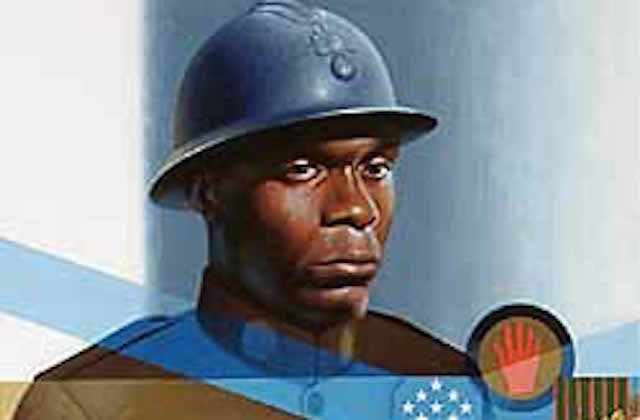
The U.S. organized two divisions of segregated men, the 92nd Division and the 93rd Division for World War I. The 92nd would carry the name “Buffalo Soldiers” as their nickname and the 93rd would be known as the “Blue Helmets.” Even though these Black soldiers established an African American presence in the AEF, American leaders at the top would still shun them. Much of the 92nd would be relegated to logistics and support, behind the front lines. When both divisions arrived in France, General John "Black Jack" Pershing was more than willing to lend both divisions to the French army to fight under the French command and flag. Parts of the 92nd would see combat action in France while mostly all of the 93rd would fight in combat.
These African-American soldiers would wear the American uniform, but would don the blue French helmet and utilize French military equipment. They quickly dispelled the American Army’s belief that they were inferior soldiers as they heroically and valiantly fought in fierce combat throughout the war. As a result of their actions, France would award several honors and medals upon multiple regiments in both divisions. Most African-American soldiers, whether fighting for the AEF or the French military, experienced a great deal more freedom in France than they did in the U.S. Though the French had their own racial issues, Black Americans found the country devoid of Jim Crow segregation.
Many African-American soldiers interacted with African soldiers and laborers from the French colonies in North and West Africa. African-American soldiers also became cultural ambassadors, introducing France and the world to jazz through the various regimental bands that took the country by storm. World War I created opportunities for African Americans to demand their civil rights, in and outside of the Army. Moreover, the war transformed the racial and political consciousness of a generation of Black people, especially those who served in the military. This would shape the activism and everyday resistance of Black people throughout the postwar period.
The “Double V” campaign — victory at home and victory abroad — adopted by African-American leaders during World War II was informed by the lessons of World War I. African American women played a central role in the war effort. Existing networks of Black women’s organizations mobilized on the national and communal levels to provide support for African-American soldiers at training camps throughout the country Black women also served in various social welfare organizations like the Red Cross, YMCA and YWCA to provide much needed support to Black troops in the face of institutionalized discrimination. As they supported African-American soldiers, Black women also used the war effort to advance their own claims to equal citizenship.
When the Black soldiers returned from the front in 1919, many experienced hostility, finding themselves subject to verbal abuse, assault and even lynching. Though members of both the 92nd and 93rd Divisions served valiantly on the front, the Wilson Administration refused to allow them to march alongside their White counterparts in official victory parades in France after the war. Thousands returned to segregated communities, and despite serving their nation, Jim Crow laws denied them many of the rights associated with American democracy. Black leaders such as W.E.B DuBois continued to press for social change, but the “return to normalcy” of the 1920’s and the Depression in the 30’s did little to change social dynamics.
Dr. Du Bois hoped that the war would provide an opportunity to challenge European imperialism in Africa and lay the foundation for the gradual independence of African peoples. Du Bois organized a Pan-African Congress in February 1919 in Paris with the goal of pressuring the assembling representatives of the Versailles Peace Conference to take the future of Africa seriously, especially in relation to Woodrow Wilson's proposed League of Nations. However, the experiences of Black soldiers in World War I set the stage for the civil rights movement that emerged after the Second World War, when civil rights activists and Black leaders ensured that established authorities would not continue to deny them civil liberties.
Even though African Americans faithfully served their country, they returned to the United States to experience a lack of employment and educational opportunities, and an increase in racial oppression, violence, and lynchings. In the wake of the war, there was a surge in racial violence. Race riots erupted in several cities, the most significant occurring in Washington, DC, and Chicago. In October 1919, Whites in Elaine, Arkansas, massacred hundreds of Black people in response to the efforts of sharecroppers to organize themselves. Many Black veterans were victims in the wave of racial violence in 1919 that came to be known as the "Red Summer." Despite this treatment, African American men continued to enlist in the military, including veterans of World War I that came home to such violence and ingratitude. They served their county in the brief period of peace after the World War I, and many went on to fight in World War II.