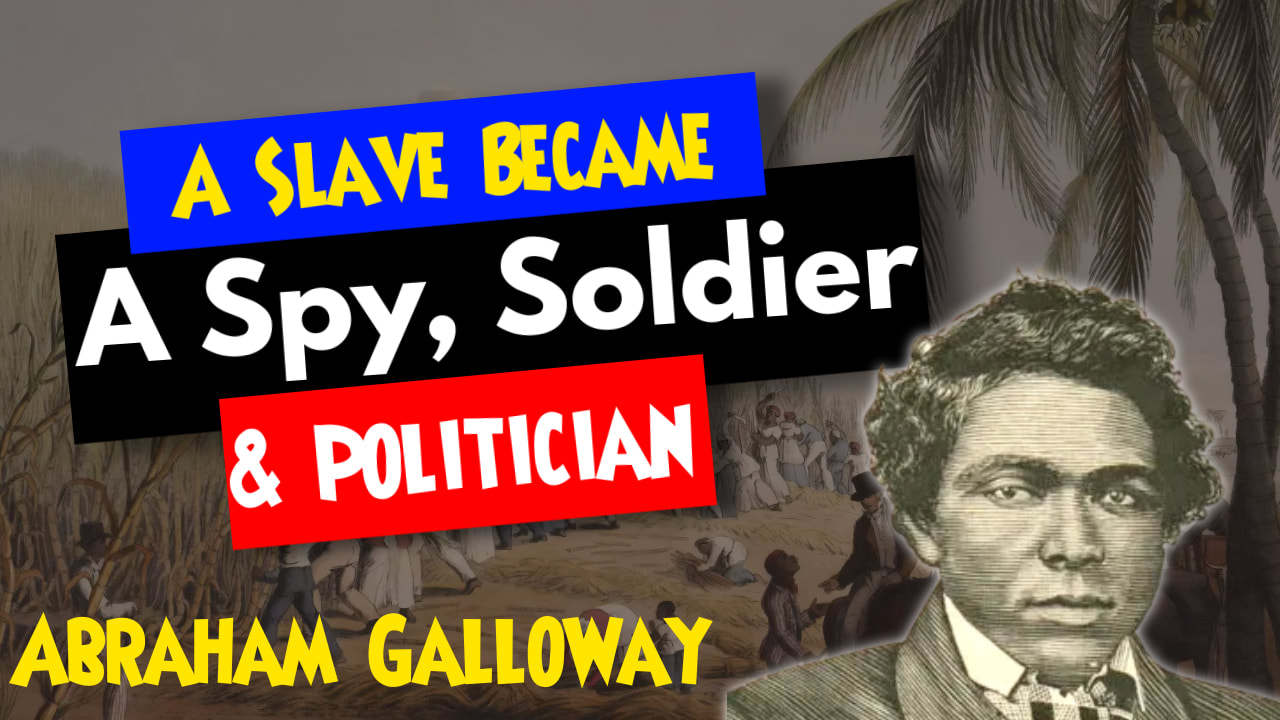
He’s been called a master spy, a military recruiter, militant abolitionist, advocate for Black suffrage, but few people know of Abraham Galloway and his role in the Civil War and his leadership during Reconstruction. Abraham Galloway was born on February 8th, 1837, in what is now Southport, North Carolina, a small coastal town in Brunswick County, N.C. His mother was enslaved and his father was a White man. Abraham was owned by the widow's son, Marsden Milton Hankins. He grew up in a world where he had to learn spy skills just to survive. His birth father was protective of his son, despite the circumstances. At age eleven, he was apprenticed to a brick mason, and eventually became skilled at the trade. Before Galloway’s 20th birthday, his owner, Hankins allowed the young Galloway to seek brick masonry jobs in Wilmington with the provision that he could bring Hankins 15 dollars a month.
Soon after he became a master brick mason he moved with his enslaver, Marsden Milton Hankins, to Wilmington – North Carolina’s largest city to work as a mechanic and engineer. Galloway decided to escape when it became impossible for him to continue bringing his owner the money in light of tightening economic conditions in Wilmington. Abraham Galloway, alongside a fellow slave, Richard Eden found the opportunity for freedom. Under the eye of a sympathetic captain—secreted himself in the cargo hold of a schooner bound for Philadelphia. The two sought assistance at the offices of the Vigilance Committee of Philadelphia, the city's oldest abolitionist organization, and met one of the group's leaders, Underground Railroad operative William Still.
To ensure their safety, Still supplied Galloway, Eden, and a third fugitive slave, John Henry Pettifoot, train tickets and a list of contacts to assist them on a journey to Kingston, Ontario, Canada. On July 20th, Eden wrote Still a letter confirming the party's safe arrival in Kingston and connecting with Mink. He also mentioned that Galloway had found work as a brick mason. In subsequent years, Galloway became a conductor, helping fellow enslaved Blacks find their way to freedom. He travelled frequently both within Canada and back into the United States. In December 1860 he went to Boston to prepare to sail to the Republic of Haiti. Galloway traveled to Haiti to join revolutionaries planning an attack on the American South that never materialized.
In January 1861—just three months before the firing on Fort Sumter—the 23-year-old Galloway sailed to Haiti, along with several other militants, including Francis Merriam, a survivor of John Brown’s abortive raid on the Harpers Ferry arsenal. The group’s agenda was to recruit volunteers for a John Brown-style military invasion of the Southern states, with Haiti as their base of operations. The start of the war put an abrupt end to their efforts, though. In April 1861, he returned from Haiti and began working as a spy for the Union under Major General Benjamin F. Butler in North Carolina, Louisiana, and Mississippi. As the Civil War began, the Union Army realized it needed better military intelligence inside the South. Abraham Galloway was the perfect type of spy they needed.
For the next two-and-a-half years, he reported directly to Maj. Gen. Benjamin F. Butler, and traveled surreptitiously through North Carolina, Louisiana, and Mississippi, disappearing within Black communities while gathering intelligence. He set up a network of spies in the South, passing information to the Union Army, and even going hundreds of miles into Confederate territory to rescue his mother. He was an advance supply scout who would reconnoiter Confederate territory prior to Union military action. All the while, he had to evade Rebel troops, slave catchers, and White civilians. His knowledge of the South was valuable in gathering information for the Union army. When the Union planned to raid a Confederate fort in Wilmington, N.C, Galloway was the perfect insider to scout the North Carolina coastline for the best landings. In 1862, Butler was reassigned to command the newly-formed Department of the Gulf.
Galloway was transferred along with the commander to federally-held land in Louisiana. Shortly thereafter he was attached to federal forces operating near Vicksburg, Mississippi. He became one of the Union's most trusted spies. In 1862, while scouting in Vicksburg, Mississippi, Galloway took on a mission that led to his capture and arrest. When Gen. Butler was ordered to lead an attack in New Orleans in February of 1862, he knew having spies along would be helpful and brought Galloway who had never been to the Deep South. After reaching New Orleans, Louisiana on May 1st, Galloway traveled immediately to Vicksburg, Mississippi which if the Union could take would split the south in two. The Union could not overcome Vicksburg, and eventually they were forced to abandon the effort and leave behind the enslaved people they had used in the effort as well as Galloway who had been captured.
He escaped and he ultimately made his way to New Bern, NC. where he appears to have taken on a final intelligence mission for Butler. Galloway may have worked for the Union Army, but he didn't trust it. He'd seen racism within its ranks firsthand. In Vicksburg, MS, he was attached to a Union regiment that tried to dig a strategic canal across a bend in the Mississippi River. When Union soldiers began to get sick and die from disease and exhaustion, they enlisted African Americans from nearby plantations to take their place. Many of them also fell ill and died. The ditch was never completed, and the Union Army withdrew, leaving the African Americans behind. Still, for all of his mistrust, Galloway helped recruit thousands of Black soldiers for the Union army. He also served as a guide for Robert Hamilton, a Black journalist for the newspaper the Anglo-African, leading him through freedmen settlements.
His career in espionage at an end, Galloway divided his time between creating entire regiments by recruiting African Americans from New Bern’s large Black population into the Union Army, and actively advocating for abolition. He helped raise three regiments of United States Colored Troops. During this time, Galloway goes from being a sort of master spy to being a leading Black political leader. During the summer of 1863, Galloway spoke for many events, raised funds, recruited Black soldiers. By the end of the Civil War, Blacks comprised 10 percent of the Union army. He also kept his ties to other abolitionists.
At this time, he met and married 19-year old Martha Ann Dixon, the daughter of a slave from Beaufort, S.C. Martha Ann shared her new husband’s burning passion for abolition and Black suffrage, and composed several fiery missives for the Anglo-African newspaper. A powerful speaker, Galloway drew large crowds, whom he impressed with his eloquence and fervor. By the spring of 1864, the war still had another year to run. In May 1864 Galloway led a delegation of African American men from the South, some of them former slaves to the White House. They presented a petition to pressure President Abraham Lincoln into promising political equality and full citizenship to African Americans if the Union wins the Civil War. Abraham Galloway was the first to sign the petition.
By now, there were tens of thousands of Black men in blue uniforms, and Galloway’s priorities had grown from simply promoting Black enlistments into the Union Army. Looking to a postwar future, he broadened his scope to include unilateral Black suffrage, as well as social and political equality. To his thinking, America’s Blacks should, and eventually would, vote and hold public office. Lincoln had met with Northern Black luminaries, including Frederick Douglass, during the course of the war, but this was his first meeting with African American leaders from the South. The president listened respectfully to their comments and gave them "assurances and cooperation". The delegation then walked to the Capitol, where they distributed copies of the petition to the congressmen.
After his visit to the White House, Galloway led members of his delegation on a tour of the Northern states, during which he took every opportunity to speak on behalf of Black suffrage. That same year, Galloway was also one of the 144 Black leaders who attended the National Convention of Colored Citizens of the United States, which has been cited as the most important gathering of Black leaders during the Civil War. He was one of only two from North Carolina. At the first meeting, the convention named Frederick Douglass its presiding officer. Each state was entitled to have a delegate serve as a vice president of the convention and have a seat on the Committee for Permanent Organization; both spots were granted to Galloway. By 1865, Galloway had organized a state chapter and five local chapters of the National Equal Rights League. After the Civil War, Galloway continued to fight for the rights of Black Americans.
Galloway returned to Wilmington, North Carolina's largest city at the time, in the autumn of 1866 and was selected to represent North Carolina as a delegate to the National Convention of Colored Men of the United States. Galloway was one of three Black senators and 18 Black representatives in the North Carolina General Assembly of 1868–1869. He was threatened with assassination with each step he took, due to his political beliefs and his actions. Abraham did not follow racial customs, refusing to set aside to let White men pass him on the street or to allow White customers to make purchases ahead of him in shops. He openly carried a pistol. He never learned to read but used his powerful oratory and organizing skills to fight for Black people’s rights as citizens.
Galloway was a naturally gifted orator and extremely influential Black Republican, the kind of Republican and African-American, the Democratic Party and the Klan was fearful of. In his speeches to Black audiences, he employed sarcasm and irony when ridiculing Whites. Known for his fiery oration and his passion when speaking on equality and political rights, in 1867 Galloway said, “There is a bright future before us - the day of rejoicing is at hand - Let us stand united - let there be no divisions. Let us shout that we are a people, and that our freedom is not a bar to our advancement. Let the work go on, and be hopeful, for the Great Jehovah still hears the prayers of the downtrodden.” North Carolina's Black Code was passed in 1866, restricting the rights of African Americans. African Americans, however, did see a victory in the next year, when the Reconstruction Acts were passed by the radical Republican congress.
In 1870 Galloway was elected for a second term to the state senate. Galloway was able to vote for the 14th and 15th amendments during his tenure. Many Whites in North Carolina reacted violently to the U.S. granting citizenship to African Americans and the right to vote to Black men. Racist groups emerged to violently suppress Blacks. The most notorious of these was the Ku Klux Klan which was infamous for intimidating, maiming and murdering African Americans throughout the South. Galloway reacted to this violence by organizing a local militia in North Carolina. They were organized under state law and his militia was called the 1st Regiment, North Carolina Defense Militia. Governor Holden commissioned him a lieutenant colonel as well as its commanding officer. Being a veteran and an African-American he knew the importance of defending himself and his fellow citizens against the widespread Klan violence.
In the General Assembly he worked for labor rights, issues familiar to us today: minimum wages, regulate hours of work. He introduced the first amendments for women's suffrage. He is remembered as a driving force in shaping local and state political direction during his brief lifetime. This former slave played an important role in supporting the Union Army's success in North Carolina. He was also a strong supporter of women's rights. He was one of the first Black Americans elected to serve in the North Carolina senate during the Reconstruction period. Abraham Galloway was just 33 years old, when he died unexpectedly on September 1, 1870, just six months after the birth of a second son, Abraham Jr., and shortly following his reelection to the state Senate. Ultimately, in advocating for Black suffrage and social equality, Abraham Galloway was a civil rights leader at a time when the concept of civil rights had not yet been fully formed. Had he lived longer, history might well have ranked him alongside Frederick Douglass as one of the most influential Black men of his time.